
Women have made great strides in the theatre sector over the past few years.
Time to rest on our laurels? Of course not – but what happens next?
This article was originally featured in the ETC Journal 2026/27.
A conversation on gender with four of Europe’s key cultural leaders:
Cláudia Belchior
ETC President & Performing Arts General Executive Coordinator of Centro Cultural de Belém, Lisbon/Portugal
Iris Laufenberg
ETC Secretary & Artistic Director at Deutsches Theater, Berlin/Germany
Judith Videcoq
Head of Unit for Creative Europe at the Directorate-General for Education, Youth, Sport and Culture of the European Commission
Heidi Wiley
Executive Director, European Theatre Convention (ETC)
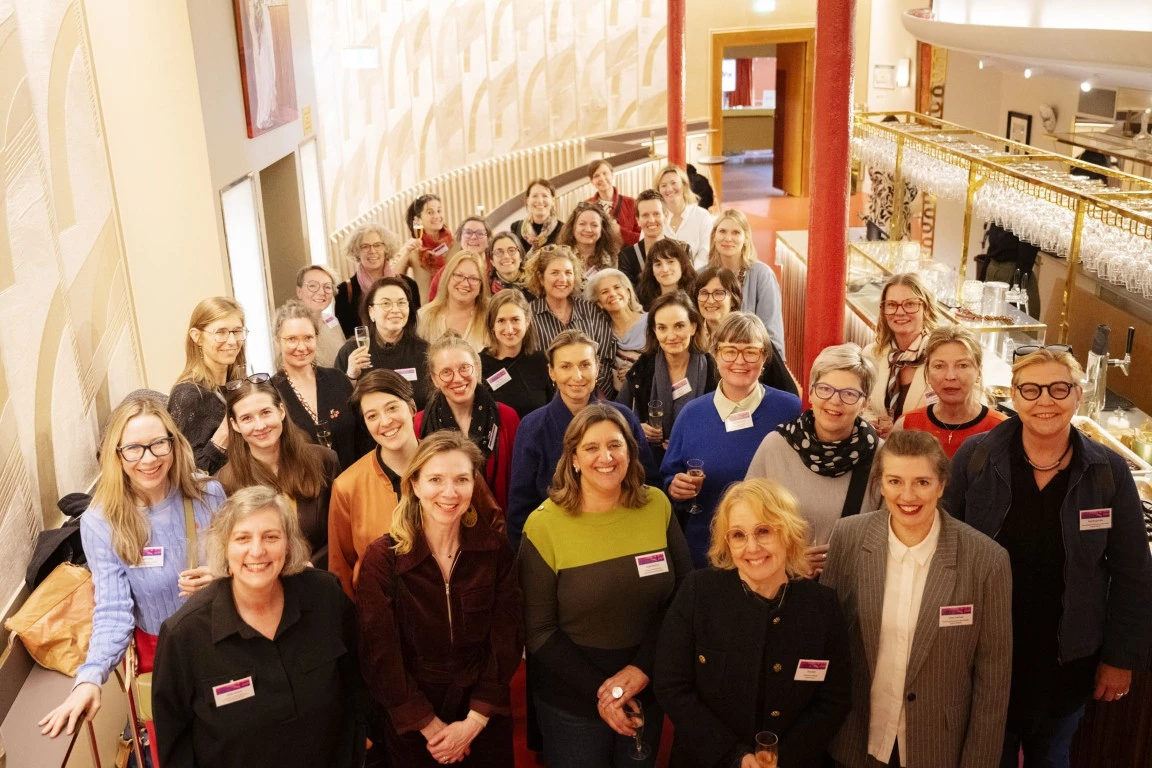
ETC recently celebrated a huge milestone: Thanks to the initiative “The 50%: Women in Leadership,” half of ETC’s publicly funded member theatres are now led by women. At our recent ETC International Theatre Conference in Gothenburg, we heard from member theatres across Europe speak about gender.
Claudia, how would you describe the current situation for women in theatre in Portugal?
Let’s first look at the overall political situation. To name one worrisome example, the current government is against quotas for gender. Now women are again a minority, both in government and in the private sector. Shifting to theatres, we see a big gap in terms of directors and for technical teams. We still have a long road ahead of us to fill these gaps.
Iris, could you tell us about your experiences in Germany?
Women are still in the minority at German theatres and opera houses. The German Cultural Council has published the following figures: 44 per cent of opera directorships, 47 per cent of drama directorships and 40 per cent of administrative directorships are held by women. There is a particularly pressing need to close the gap when it comes to artistic directors and general artistic directors, where women account for just about one quarter of appointments. You almost need a magnifying glass to find female chief music directors: there are just two women in this role, compared with 58 men in Germany. At the Deutsches Theater Berlin, I am the first female artistic director since its founding about 150 years ago. Isn’t that absurd? So there is still a great deal that needs to change. Gender equality is hardly a reality at any theatre. We still have departments that can be classified as traditionally male or female. As a theatre director, I am also responsible for addressing this issue, and I would be taking the easy way out if I were to focus solely on the appointments themselves. The work often begins with the basic requirements: for example, we still often lack facilities for female employees, such as changing or break rooms. At DT, we are aware of these shortcomings and try to implement appropriate measures step by step. This takes time and is structurally complex, but it is a fundamental prerequisite for ensuring that structures can change in a long-term and sustainable way.
Judith, can you frame these insights from a policy perspective?
First, I would like to congratulate ETC and its members on achieving this important milestone – this is an encouraging sign of progress in the cultural sector, and in particular in the performing arts. We see momentum building and glimmers of hope across Europe; to name one example, at this year’s Festival d’Avignon, for the very first time a majority of the festival’s directors are women.
On the other hand, I find it remarkable that the cultural and creative sector still lags behind overall in terms of gender. In Europe’s music sector, women represent 20 per cent of registered composers and songwriters and earn on average 30 per cent less than their male peers. Looking at the performing arts sector, data from France shows that women make up the majority of theatre students, but they earn less and have fewer responsibilities than men.
Heidi, how can we ensure more gender parity across the diversity of ETC member theatres?
We need to keep it high on the agenda. Everywhere we see a backlash and less interest than we saw five years ago in the wake of the #MeToo movement. We launched our structured programme in 2018, first conducting studies. And then, of course, we didn’t just let the studies collect dust in the filing cabinet, but instead we put these insights into action.
First, the data showed declining levels of parity over the years. While 50 per cent of ETC theatres are led by women, we found a great disparity in terms of age and geography. For example, we found that young women, especially in Central and Eastern Europe, struggle to make progress. We need to encourage more women to work in technical careers and improve conditions, through programmes like peer learning. We had additional support for directors and dramaturgs but need to ensure long-term viability of these.
Iris, can you comment on the recent debates on the gender quota around the “Berliner Theatertreffen” in Germany?
I was genuinely concerned by the news that the women’s quota will be suspended for two years at the Theatertreffen. To clarify, the quota strove for gender parity in terms of directors the invited guest performances. That’s why I signed an open letter together with 300 other cultural professionals opposing this suspension. To this day, I am alarmed by the media debate that has unfolded in response to the suspension of the quota and the letter. I would like to emphasise once again: this was never about questioning the jury’s independence. Of course not! The broader point is to stay the course and support increased visibility for female directors – not backtrack right after the first successes.
I headed the Berlin Theatertreffen for nine years; back then, in any given year there was usually just one female director among the ten most notable productions. As a result, together with the festival director at the time, I appointed a jury in which, for the very first time, more than 50 per cent of jury members were women. Unfortunately, this did not initially lead to more female directors at the Theatertreffen. I therefore thought it was brilliant that the jury itself later introduced the women’s quota. Even though I would wish it were not the case, we are not there yet, in any field. I consider the suspended women’s quota to be the wrong signal, especially in light of the clear socio-political backlash we now see.
Let’s shift to the artistic level and consider gender and a diversity of voices on stage and in stories. In her address at the ETC International Conference, legendary director Katie Mitchell advanced a number of theses urging theatres to “reflect on their choice of repertoire wearing the glasses of gender equality.” How can we ensure this?
Claudia: It’s important to note that our theatre doesn’t have an ensemble. When we design the season, we also consider what kind of diversity we can offer in terms of repertoire and casting. When selecting partners, we are vocal about this issue as it is a central part of our mission.
As you know, even in the 1970s, Portugal was a traditional country with conservative values. Against this backdrop, women’s stories are highly relevant. It’s so easy to forget the recent past. These behaviours continue nowadays, likely because of the populist discourse so prevalent now.
Iris: When putting together the season programming, we look very closely at what we are staging and who we cast; this applies to the direction, the ensemble cast and also the selection of playwrights. We always track the figures, and whilst we do not yet have a 50:50 balance across the board, we always have gender equality in mind. At this year’s Autor*innenTheaterTagen, for example, the proportion of female and male playwrights invited to the festival was balanced.
I have long-standing and successful working relationships with a number of brilliant female directors, including Claudia Bossard and Anita Vulesica. Anne Lenk and Jorinde Dröse, Ildikó Gáspár and Anica Tomić also regularly direct productions at DT – they are important voices representing different generations of women, whose styles, narrative approaches, and perspectives shape our programmes.
When I look at our programme for the 2026/27 season, one thing becomes evident: We are living in a time of upheaval; old certainties are crumbling, societies are reverting to archaic patterns, and fear, power struggles and exclusion are on the rise – and yet, at the same time, the longing for solidarity, empathy and ideas for a new way of living together become more palpable. I find this new way of living together, amongst other things, in collaborations such as that between the DT and the Thalia Theatre in Hamburg under the new artistic director Sonja Anders. Women don’t just lead differently; they may also find synergies and partnerships in different ways. For example, I am trying to create something new with Sonja Anders: we are staging a co-production featuring an ensemble composed of actors based both at Thalia and at DT, aiming for a kind of artistic doubling for both theatres.
Heidi: With our Diversity in Action Code we were very clear about where we want to see gender parity: backstage, onstage, and – most importantly – whose stories are we telling? Roles on stage should be representative. This is a guiding principle when we commission new works and consider casting choices, for example. This holds true for all the minorities that we want to represent in theatre. This is crucial work for contemporary creation.
Shifting from the human perspective to the numbers: As we have seen, data collection is key. Shifting behind the scenes, Mitchell also urged theatres to share their statistics on gender parity behind the scenes. Can you discuss discrepancies in the various departments?
Heidi: We need regular data collection to have comparable data. We can do what is within our means and we keep pushing for it. However, there is still room for improvement.
Speaking of room for improvement, how can policy help?
Judith: It is the role of policy to support and mainstream good practices. This is what we try to do with Creative Europe. We can use it as a tool to promote inclusive practices and strengthen the stronger positioning of women in the cultural and creative sectors. We have included gender equality as a key evaluation criterion for projects in Creative Europe. All proposals submitted need to demonstrate how they will achieve this goal. This includes promoting equitable participation of women, specifically in decision-making roles and also ensuring that female creatives are represented in project outputs and narratives.
In terms of figures, if we look at 2021-2025, the EC allocated about 270 million EUR to projects with the principal objective of improving gender equality. In terms of statistics, we collect a lot of data and are especially interested in disaggregated data on gender. Here we can see encouraging figures: For example, figures from the mobility programme “Culture Moves Europe” from 2025 show that a majority of women benefited from these actions. As a next step, we need to really look at how this kind of mobility scheme can help women build careers and move into leadership positions.
Claudia: I agree that the data serve as an important barometer to show which areas need more advocacy.
Iris: Statistics on gender at Deutsches Theater have been assessed annually since my predecessor’s time; there is a brochure on the subject and a plan to promote women. As artistic director, I give great importance to measures aimed at significantly increasing the proportion of women, particularly in technical departments. However, we still experience resistance against gender equality, which could stem from uncertainty or the fear of losing privileges. This makes it all the more important that we, as theatre directors, clearly commit to the goal of ensuring that theatre is a place where not only wide audiences feel comfortable and even at home; the issues we address on stage should not stop at the staff level. And yes, I would also like to see more support from politicians in this area. Statements calling for an end to gender-neutral language, as we have recently witnessed at a federal level in Germany, definitely send the wrong signal.
Let’s shift from gender and move to the broader topic of working conditions. The current call for the European Artistic Freedom Act closely links artistic freedom to working conditions for artists, and it is also a focus of the Culture Compass. What hurdles do women face in practice that hinder their full artistic freedom? Are there additional considerations for working mothers?
Judith: In terms of working conditions, this is a major focus of the Culture Compass. We know that the conditions are very precarious, as the sector sees a lot of freelance work, and almost one-third of cultural workers are self-employed – this is more than double the EU average. In addition, contracts are often shorter and less stable. In the sector, the rate of permanent employment is about 15 per cent less than in the general labour market. There is also a significant gender gap in terms of remuneration. That’s why we try to encourage Member States to share good practices; for example, several countries have adapted artist status legislation. At the EU level, we believe it’s important to step up and improve artists’ working conditions. That’s why the Commission is preparing an EU Artists Charter with principles, guidance and commitments for fair working conditions and to increase compliance for EU funding in culture. We will develop this Charter in consultation with social partners and stakeholders, and aim to present it by mid-2027.
Heidi: Claiming your rights shows a powerful stance, especially if you belong to a vulnerable population. At ETC, we have started to look at the role of childcare for working mothers, an issue that has long been neglected. The reality of working hours is quite intense, with long hours and work on nights and week-ends. We don’t have ready-made solutions for this; we still lack uniform standards for benefits like family leave. This question affects all of society, not just the sector. We need to have a dialogue across Europe and see what ETC can do.
Iris: When I was Artistic Director in Graz, the opera house was also run by a woman, Nora Schmid, who had recently become a mother. We both kept hearing the same question in interviews: “How do you balance childcare with work?” Besides the fact that my children were already a bit older, a male colleague would never have been asked that, even if he had a newborn. Fortunately, I’m no longer asked that question here in Berlin, but the persistent emphasis on the fact that I’m the first female artistic director of the DT shouldn’t be considered positive – it still implies that a woman at the helm is highly unusual – but it isn’t! We need to shift the narrative. What’s strange is that I am the very first woman to lead DT!
Claudia: In Portugal, we introduced legislation for freelancers, who now can have access to unemployment subsidies, retirement funds and an employment allowance. Colleagues in other countries are asking about this, as it’s really improved the situation on the ground for our colleagues.
From the political to the personal: You are all esteemed cultural leaders. What advice would you give to your younger selves?
Judith: I would say, “Trust yourself more.” Don’t underestimate your skills and be kinder to yourself. This is the same advice that I always give my daughter. So, even if we are convinced on an intellectual level that women have all the qualities to succeed in leadership positions, we continue to unconsciously treat girls and women differently. These messages in turn shape their self-perception and potential, and can damage their confidence. This is unfortunately passed down from one generation to the next.
Claudia: I agree that we need to be kinder to ourselves. That said, this issue is still difficult for me. I’m almost 60 but I feel 20 when I talk about it. We need to be more secure in our abilities and know that we are on the right path.
Iris: Don’t give up! Keep at it and, above all, find allies, form partnerships, build networks – ETC is a good example of this kind of network. Driving change in the face of adversity is easier and more fulfilling when you have like-minded people by your side.
Heidi: Don’t be ashamed to ask questions. These days, I now consciously look out for other women leaders as role models. And: Don’t wait for permission from powerful men to do things. Because we have a lot of them in theatre!
The interview was conducted by ETC Senior Strategist for Communications, Fundraising & Advocacy Amy Pradell and edited for brevity.