
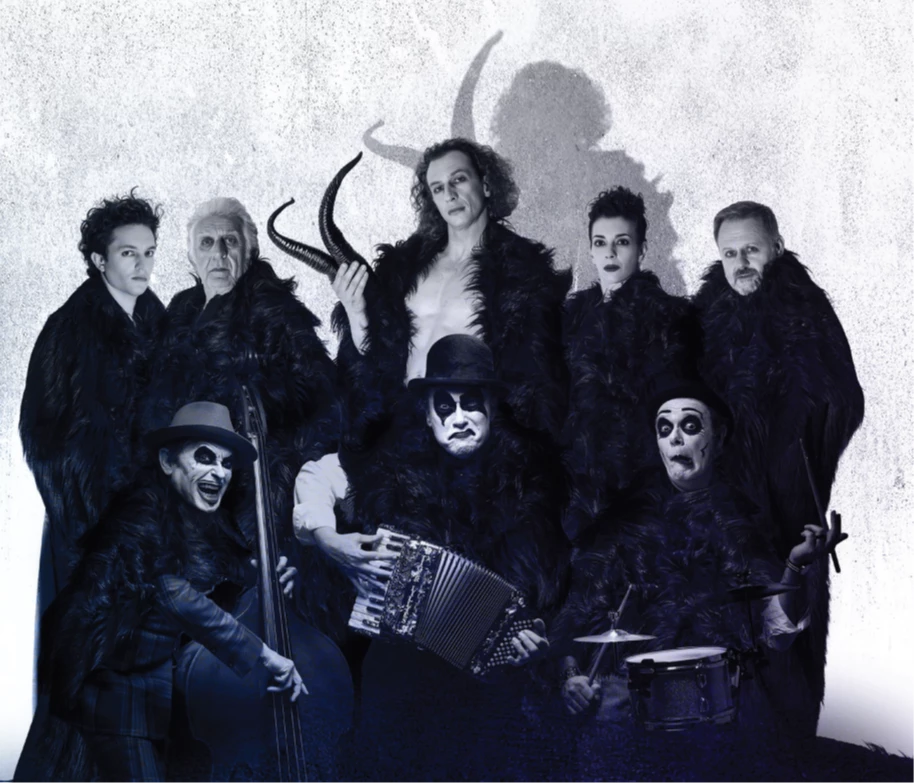
Large-scale Bulgarian-Greek Production of 'Bacchae' Premieres in Sofia and Plovdiv
'Bacchae' by Euripides, directed by Javor Gardev and with the special participation of The Tiger Lillies, is a large-scale Bulgarian-Greek co-production between the Ivan Vazov National Theatre, the Athens Epidaurus Festival, and the National Theatre of Northern Greece in Thessaloniki. The world premiere of 'Bacchae' took place on 10 and 11 July 2026 at the Ancient Theatre of Epidaurus as part of the Athens Epidaurus Festival to much critical acclaim. A summer tour followed, during which the performance was presented at numerus ancient theatres across Greece. The Bulgarian premiere of Bacchae will take place on 30 September 2026 at the Ancient Theatre of Plovdiv, followed by a performance on 9 October at Hall 1 of the National Palace of Culture in Sofia.
The production features a special live appearance by the British musical trio The Tiger Lillies, comprising Martyn Jacques, Adrian Stout, and Budi Butenop. The world-renowned musicians take on the role of sinister rhapsodes - figures elicited from the very heart of the Dionysian cosmos - performing live eleven original songs written by Martyn Jacques especially for the production, who further amplify the dramatic action.
The production's cast features twenty leading actors from Bulgaria and Greece, including Samuel Finzi as Tiresias, Leonid Yovchev as Dionysus, Alexandros Milonas as Cadmus, Loukia Michalopoulou as Agave, and Michail Tabakakis as Pentheus. Ivan Yurukov, Martin Dimitrov and Ivan Nikolov also are part of the cast and the Chorus consists of: Alexandra Gaithatzi, Alexandra Svilenova, Angeliki Kintoni, Danae Stamatopoulou, Eleni Thimiopoulou, Efthymia Danilidou, Kremena Slavcheva, Nadya Keranova, Nefeli Anthopoulou, Polixeni Spiropoulou, Xenia Grammatikou and Zoe Eftimiou.
In Gardev’s Bacchae, a critical question takes center stage: how much destabilization can a society endure? How does the collective body metabolize an event – mentally, psychologically, and politically – before it hardens into trauma? The tragedy becomes a reckoning with the limits of orderliness, testing the resilience of both rules and institutions alike. In Euripides’ vision, Dionysian ecstasy is no carefree celebration; it is a trial for civilization itself, pushing to extremes our obsession with control, custom, law, and self-image.
As the director himself stresses, “Bacchae ventures further than any other tragedy into the territory of irrational impulse and madness. So far, indeed, that it becomes perilous even for its audience, who are invited to confront their innermost fears and most potent fears.”
The atavistic dread of civilization's collapse does not reside solely in the dramatis personae; it nests within the collective unconscious, where communities forge myths to shield themselves. From this premise, an unsettling parallel emerges with the experience of different nationalisms, in which bigotry – a politicized fear of the Other – transforms difference into a threat, something to be repelled, contained, or forcibly assimilated. Therefore, the tragedy is founded upon the delusion and folly of believing that whatever cannot be contained within language and law may simply be banished. Yet, when humanity denies its murky kinship with the irrational, it does not eradicate it; it drives it into cavernous depths, from which it almost always returns, more feral than before.
More information on the production and tickets is available here.